


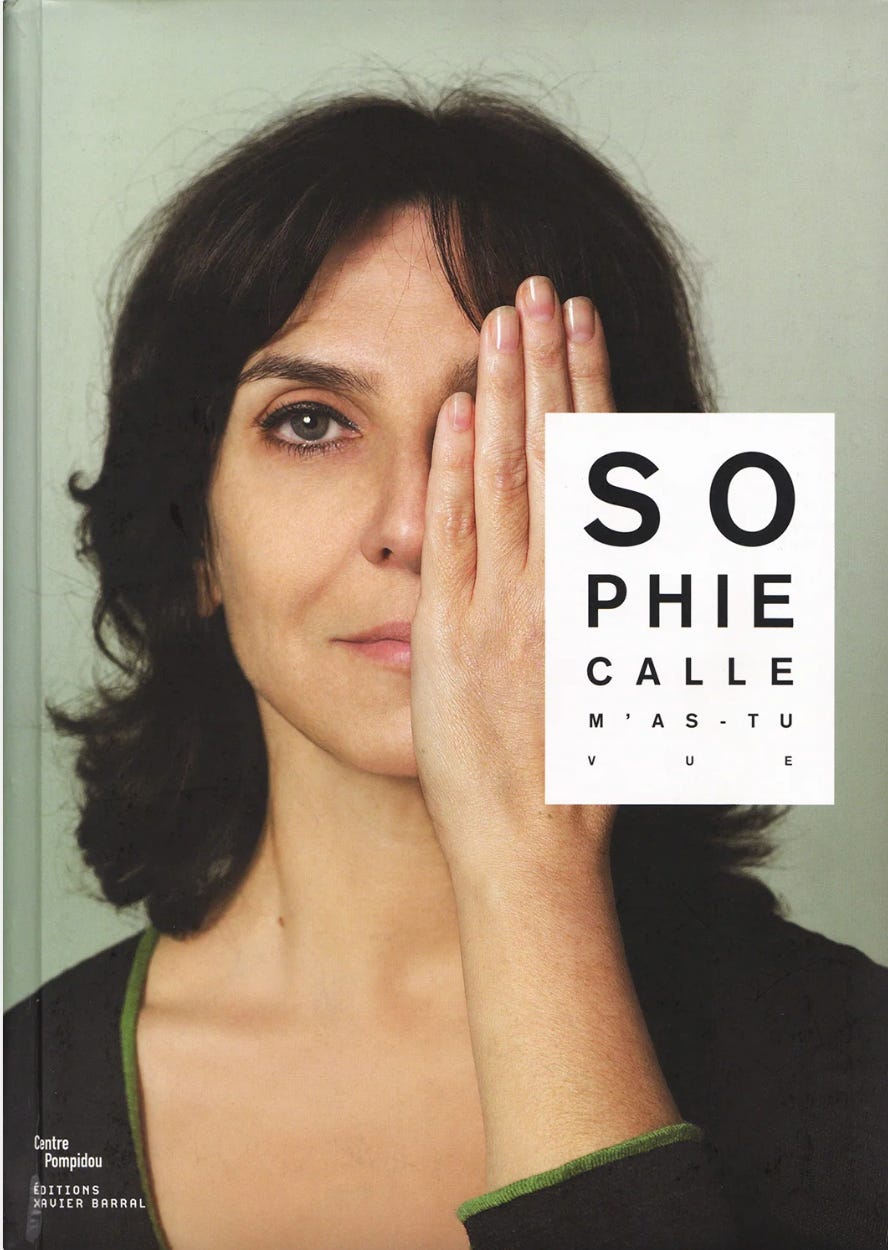
The French artist, Sophie Calle, has done many questionable things in her career:
She invited people to sleep in her bed while she took photos of them.
She pursued a stranger to Venice and documented his movements around the city.
She got a job as a chambermaid in a hotel and took photos of the occupants’ private possessions.
She found an address book on the street and contacted the people who were listed in it to learn more about the owner.
The title of a recent retrospective, Overshare, made the connection with her projects and the excesses of social media, but this seems slightly off. Her work has always been rigorously conceptual in nature. She never posts random photos online.
Since 1978, Calle has been creating rule-based situations which she documents and presents as art. She originally referred to these as “project games” or “private games” but now calls them “rituals”.
Despite playing with themes such as exhibitionism and intimacy, privacy and surveillance, she does so with a sense of mystery. It encourages the reader—this reader, at least—to play detective to see how the fragments of her oeuvre fit together.
What follows is the evidence I have gathered. A scattershot chronology of Calle’s life. It doesn’t contain her exhibition history or bibliography, just the facts of her life with as much precision as possible.
Email me if anything is missing or incorrect.
Sophie Calle Timeline
1953
Born on 9 October in Paris to Robert Calle, an art collector and oncologist, and Monique (Rachel) Sindler, a journalist.
1956
Her parents divorce.
1967-72
Aged 14, her grandparents advise Calle have plastic surgery to straighten her nose. Two days before the operation, the surgeon commit suicide.
Joins a Maoist group.
Travels to Israel1 and stays in the home of a family friend, Dahn Ben-Amotz. It is claimed in a later biography that Ben-Amotz had sex with underage girls and his mother.
Travels to Lebanon and trains as a fighter with the Fedayeen militants to impress a boyfriend.
Back in Paris, she joins an underground abortion network.
Studies sociology under Jean Baudrillard at the University of Nanterre, but drops out after only a few months. Baudrillard marks her papers favourably so her father would pay for her travels.
1972-78
Travels to the United States and becomes a barmaid.
Travels to Mexico and works in the fields.
Travels to Crete and works with fishermen.
Other jobs include selling vacuums, waitressing, cannabis farming, and working in a circus.
Travels to Bolinas in California, where she rents a house belonging to a photographer. Borrows his camera and darkroom to make pictures of graves with only “Father,” “Mother,” “Brother,” “Sister,” “First Wife” carved into them.
Aged 25, she finally knows what she wants to do with her life and tells her father she is going to become a photographer.
1978
Returns to Paris to live with her father.
Takes a photography class, but abandons it after one lesson. In the lesson, she goes to the first floor of the Eiffel Tower and takes photos of people.
Sees work by Duane Michals in her father’s house and is influenced by the combination of text and image.
To help rediscover Paris after being away so long, Calle decides to follow people.
She explores the derelict Grand Hôtel Palais d’Orsay and spends her days in the abandoned room 501. She takes photos and gathers documents from customer files.
1979
Calle follows a man (Henri B.) in Paris. She meets him later at an art opening, where he mentions a trip to Venice. This is the beginning of Suite Vénitienne.
On 11 February, she follows Henri B. to Venice, surreptitiously documenting his movements for two weeks with photos, texts, maps, and diary entries.
Over the course of eight days, from 5pm on 1 April until 10am on 9 April 1979, Calle arranged for 27 people to sleep in her bed in eight‑hour shifts while she photographed them.
The husband of one of the female participants is an art critic. He invites Calle to show The Sleepers in the modern art museum of Paris.
Calle wears a blonde wig and works as a stripper in the Pigalle district of Paris.
On 7 October, the tenant who rents her childhood bedroom from her mother set himself on fire. The firemen throw the bed out of the window. It stays in the courtyard of the building for nine days.
On 9 October, Calle turned 26.
1980
Fearing a lawsuit, Calle recreates the photographs in Venice with an actor.
Asks eight strangers in New York’s Bronx to guide her to personally significant places. She documents with portraits and text.
Starts collecting all the birthday presents she receives.
1981
On 8 January, Calle gets into a fight with a fellow stripper and abandons the profession.
Takes a job as a chambermaid in a Venetian hotel and systematically photographs and describes guests’ possessions and traces in twelve rooms over several months.
On 16 April, she asks her mother to hire a private detective to follow her for a day. Calle documents her own movements and later compares them with the detective’s report.
1982
Finds a leather-bound address book on a street in Paris. Rather than hand it straight back, she photocopies it first and then calls the numbers written in it to build up a picture of the man.
1983
The Address Book project is serialised in the French newspaper Libération. Despite being pseudonymised, the man threatens to sue.
On 30 November, she spends the night in a wedding dress with a man she had long admired.
1984
On 25 October, Calle travels to Japan via Delhi for a residency. She planned to meet up with her boyfriend there, but he never arrives. He subsequently breaks up with her on the phone.
1985
Calle returns heartbroken to Paris on 28 January and asks friends about the worst pain they have ever suffered.
Her father arranges for her to see a doctor for her bad breath. It turns out that the man is not a doctor but a psychoanalyst.
1986
Calle interviews blind people ( Les Aveugles) and asks them to describe their image of beauty.
I am going to insert a paywall now. Partly this is to encourage readers to support The Crop, but also because most of her work emerges from her early years.
If you don’t want to subscribe but desperately want to read, do email me with your most important year and why it is important. I will then send you the rest.