


In tech circles, the phrase “You Can Just Do Things” has become a meme to rouse people from their learned helplessness. You don’t need permission, they say, you just need to build.
With access to AI coding tools that make previously laborious tasks trivial, it is tempting to get carried away. And, this past week, I experienced the positive and negative consequences of “just doing things”.
On 22 October, around lunchtime, my old pal Ed Jefferson, who I knew in London twenty-odd years ago, launched Local Wikipedia, a version of Wikipedia that only includes articles within a half-hour walk of where you are. It was a long time coming. As he explains in his blog post, it began in 2020 as a “Lockdown Wiki”, and sat unfinished until he dusted off the folder this autumn.
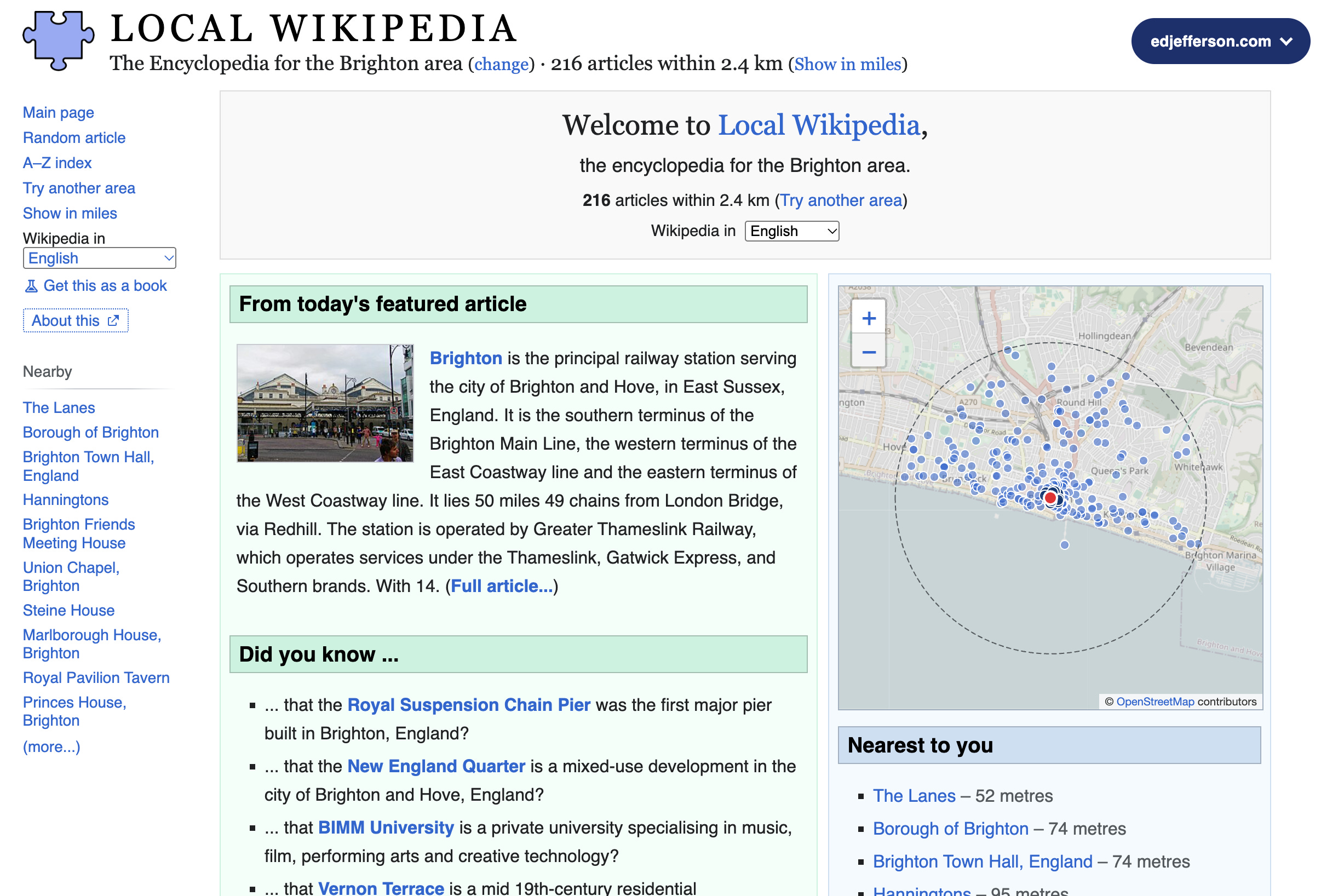
From the moment I saw Ed’s project, I was curious to see where all those places sat visually. A month earlier, I had made a map of Glasgow’s plaques and statues drawn from Wikimedia Commons, with added categories and locations pinned to OpenStreetMap.
I wondered if it would be possible to combine the two ideas: to take his local Wikipedia and transform it into an interactive map. Three hours of tinkering later, my version was live.

Making things is easy, getting traction is hard
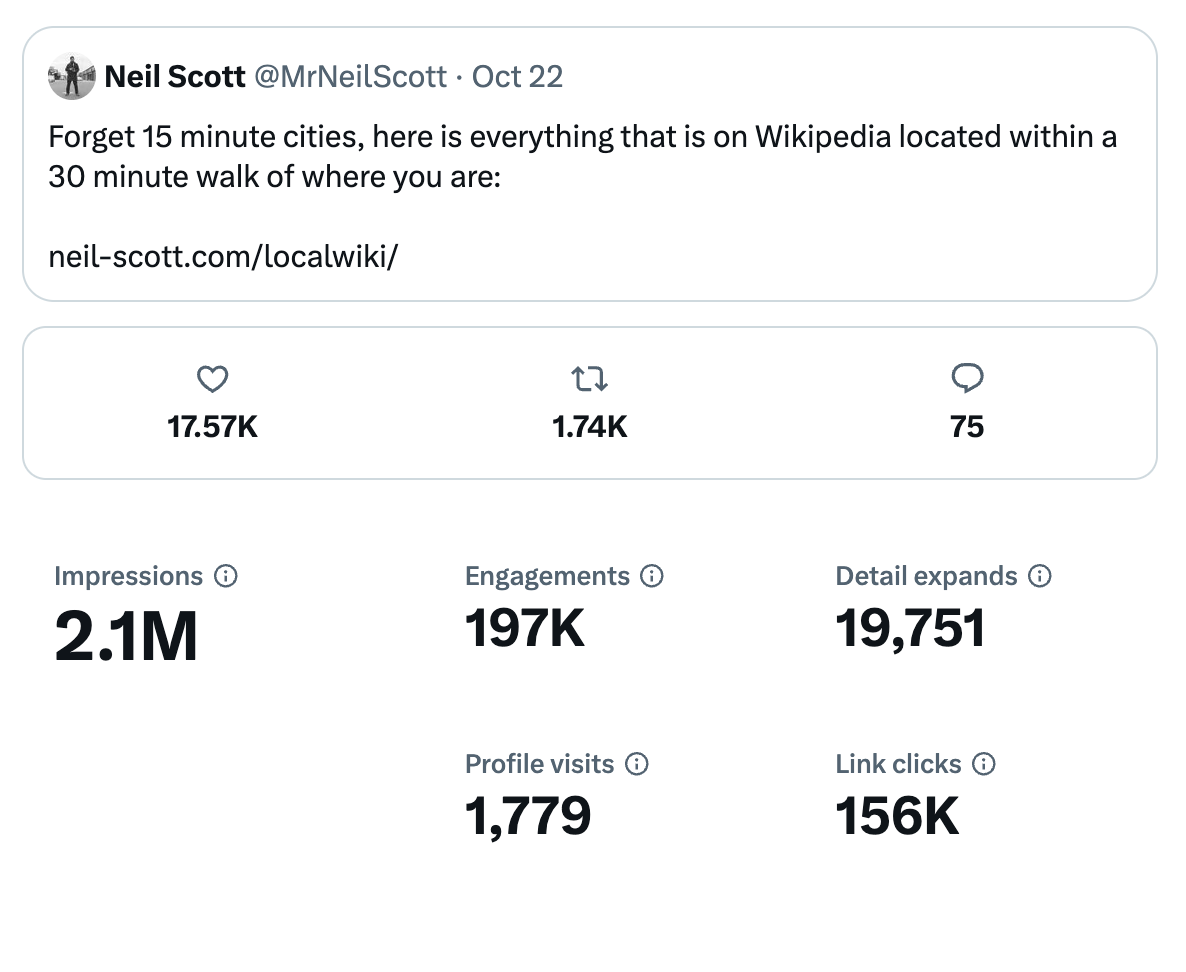
As with many of my side projects,1 I posted it to X and thought no more of it: “Forget 15 minute cities, here is everything that is on Wikipedia located within a 30 minute walk of where you are.”
Posts with links are usually restricted by the algorithm and rarely reach more than a hundred people or so. But this time was different. The writer David Wingrave quote-posted it with a simple “That’s fun, I like that.” His post was seen by 791 people. A short while later, Finlay McLaren quote-posted me, saying: “This is a great deal of fun. Highly recommended.” In a world of bloated superlatives, just saying “highly recommended” was like magic. McLaren’s post got 26,000 likes, 9,000 more than my original. Within a day, my post had over 1.4 million views.
Jude Cramer, a journalist from Fast Company, got in touch, and asked me some questions about how it came into being, allowing me to get the words psychogeographer and flâneur into a mainstream publication. It was heady stuff, but not everyone was happy.
Everything is a remix, but some things are more remixed than others
A decade or so ago, Kirby Ferguson had a hit with his series, Everything is a Remix. The premise is that there is no such thing as originality; culture comes from artists copying, transforming, and combining previous models.
Ed’s site is a clone of Wikipedia that transforms the original by limiting users to a specific geographical radius. It’s like Wikipedia’s Nearby page but with the ability to search locations.
I, on the other hand, took Ed’s idea and combined it with a map plus a simple list of categorised places.
My error was that, while I had combined elements and the thing looked different, I hadn’t much changed the name or copy.
As my version began to spread, some people got confused about which was which. An AI-written tech blog merged the two projects into one. Ed got sent links to mine, became understandably upset, and blocked me for a while. Even worse, internet personality Rob Manuel (co-founder of B3ta) started accusing me of being “not cool”, an accusation which I didn’t take entirely seriously, given that he is one of the world’s biggest nerds.
I realised my mistake, apologised to Ed, renamed my version Walkipedia (suggested to me by my friend Robbie Gordon), and made an extra effort to ensure the site was transformative, while still giving Ed credit for the original idea.
Of course, the name Walkipedia has been used many times before. And the idea of laying Wikipedia data on top of maps has been done even more often. There’s:
David Taylor’s Wiki-Map (Thanks to Mike Sowden for finding this one)
The Inquire app
And there’s even a tab on the official Wikipedia app itself
The idea is not enough. As Steve Jobs said in his 1995 interview with Robert X. Cringely, “It’s the disease of thinking that a really great idea is 90% of the work.”
Bringing something into the world means making thousands of decisions which constantly change the outcome of what you build. For instance:
Should it look like Wikipedia?
I originally borrowed the typographical sensibility of the website, but as I added features (like the ability to plot a route, suggested to me by Adam Ashby) I decided to give it a more friendly aesthetic.
Which map tiles?
By default, OpenStreetMap tiles are cluttered and messy. Fortunately, cleaner options exist.
How much of the screen should the map take?
The smartphone screen is a tricky constraint. Each Wikipedia location has a short description on the map, but this can easily clutter a small screen. By contrast, the description of what the app does and the list of categories can be lost if the map is too tall.
These decisions are trade-offs and require the clarity to choose. To quote Steve Jobs again, “Ultimately, it comes down to taste.”
People and their principles
I credited Ed in the footer of my version. I credited him on Bluesky. I credited him in my answers to Fast Company. But I didn’t mention him on the X post, partly because I know how much he hates the site.
Ed, like all good people, gave up on X when Elon Musk turned it into a platform that promotes demagogues.2 It’s not hard to see why when you click on the “For You” tab and see an endless stream of crime and disorder. But, in my admittedly privileged experience, if you just follow a small number of people and only read them, it is not much different to how it was before.
It is not inconceivable that X could be banned at some point in the future. The Scottish Greens have left the platform. This month, at their conference, SNP members voted overwhelmingly to back a UK-wide ban on X and for the party to review its own use of it.
But X is still where the crowds, the memes, and the viral moments live. In the same SNP debate, a delegate at the conference shared figures suggesting X has 551 million monthly users against 10.4 million for Bluesky. Being on Bluesky can feel like shopping at a small organic grocer’s rather than going to Lidl.
There is also Threads (the Tesco of social media?), where my friend Mike Sowden shared Walkipedia with his typical enthusiasm. Thanks to Mike, the tool was found by Jeopardy! champion Amy Schneider, who also wrote about it in glowing terms.

It was also Mike who suggested sending the site to Jason Kottke, who judiciously mentioned both in his post, while mainly featuring Ed’s version.

Outcomes of a viral moment
Walkipedia cost me nothing. Well, nothing but time and some mental wellbeing. It is built with static HTML, CSS and JS on Cloudflare, with no server-side code or database. In the first few days it handled 2.45 million requests and 679k visits. Had I built it in PHP and MySQL, as I would have a few years ago, it would have fallen over in five minutes.3
There may be some search engine optimisation value. I may have a few new subscribers. But for the most part it is business as usual. As I said to Jude Cramer, for me, the internet is not an end in itself and I find it difficult to take anything online too seriously. But, as I learned, there are consequences.
Suggestions for future development are welcome in the comments. If you’d like to buy me a coffee or take a paid subscription to my Substack, I’d be greatly honoured. But mostly, I’m happy that both Local Wikipedia and Walkipedia are out in the world. They are a reminder of the old web, when not everything was about algorithms and advertising.