


October in Glasgow. The days are getting shorter, the leaves are turning yellow, yet there is still time to get some unfinished work across the line before the year ends.
Back in January I spent a couple of hours walking around Glasgow with the documentary photographer Jeremy Sutton-Hibbert, whose reportage and editorial work have taken him all over the world.
It’s difficult to summarise his career, but he has photographed:
Politicians including Fidel Castro, Mikhail Gorbachev and Slobodan Milošević.
Writers including Muriel Spark, Salman Rushdie and Martin Amis.
Shipbuilders, Orange Order marchers and protesters.
Roma communities, Scottish artists and Common Riding equestrians.
Countless other subjects on photojournalism assignments.
In 2022, the University of St Andrews acquired his archive of more than a million images.
For photographers, an archive can be the difference between immortality and oblivion. Everyone knows the story of Vivian Maier, whose negatives turned up at an auction and made her famous after her death. But what about someone like Helmut Newton, whose lavishly funded foundation can protect and promote his legacy for generations.
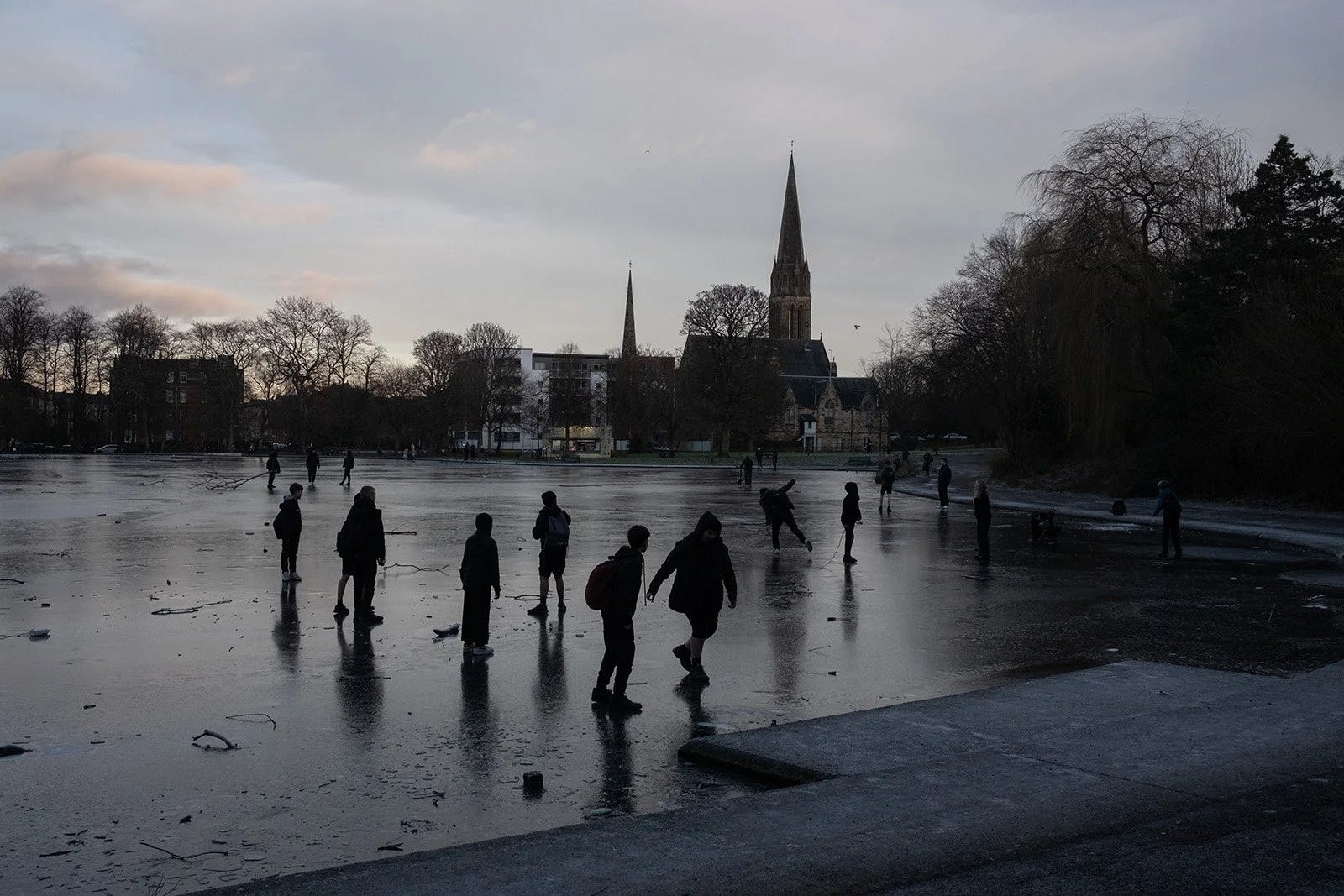
Rather than sit down face-to-face, I wanted to interview Jeremy at work. I was particularly interested in his ongoing project, Gloaming, which documents the streets of Glasgow in a crepuscular light.
We spent two hours talking about his career while I held a microphone and occasionally tried to take a photograph. The resulting 14,000-word transcript sat on my hard drive waiting to be edited. What finally gave me the impetus is that Jeremy (in collaboration with Street Level Photoworks) has an exhibition, inside Glasgow City Chambers of Nelson Mandela’s two visits to the city.


Glasgow has a long history of radical politics, from the Calton Weavers to Red Clydeside. In 1986, in defiance of the apartheid regime, the city council renamed the street where South Africa’s consulate was located Nelson Mandela Place. Yesterday, Friday 9 October, a statue of Mandela will be unveiled there. It seemed a fitting deadline for publishing this conversation about photography, memory and what we leave behind.
Neil Scott: How did your Gloaming project begin?
Jeremy Sutton-Hibbert: It was two ideas that came together: I wanted to photograph the streets of Glasgow, and I wanted to photograph in the gloaming light. I’d got into the habit of only photographing when I was sure of getting a picture. I wasn’t leaving myself open to chance. So I made a deliberate effort to photograph in the gloaming half-light of dawn and dusk, whatever I wanted, whatever I saw, and not think about it. It’s mindfulness photography.
How do you approach editing? Do you delete photos? I hear from a lot of photographers that what is good changes over time.
I sometimes joke that I’ve got a terrible business model, because I go out to photograph thinking, “These will be really interesting in 50 years’ time.” It doesn’t help me pay the bills this month.
I guess you’ve seen that happen with your own work. Your zines about Glasgow’s deindustrialisation still resonate.
I sorted out my archive over lockdown, around 2021. It was a great motivator, and I’d recommend it to many photographers. I spent the best part of nine months looking back over my whole career, going through everything, sorting it and cataloguing it. Not that I needed any validation, but it was quite nice to look over my career and think, “Wow, you worked hard.”
A by-product was that it motivated me to get out and do more. I’ve had a massive international career. I’ve been lucky to see the world, but increasingly I wanted to photograph Glasgow and Scotland. Sorting the archive freed me from looking in the rear-view mirror and let me concentrate on going forward.
I’m 56. So say I’ve got 15 years of active photography left. Say you do a project a year, or a project every two years. I’ve got 10 to 15 projects left. That’s a motivator. It gives you a goal, gives you focus. You have to be working to a plan or you’re scattered.
Is there a sense of mortality?
I’m not fatalistic. I am a realist. The reason I go to the gym is so I can keep on carrying all these cameras. Keeping healthy and fit is incredibly important if you want longevity in this career. It’s good for your sanity as well.
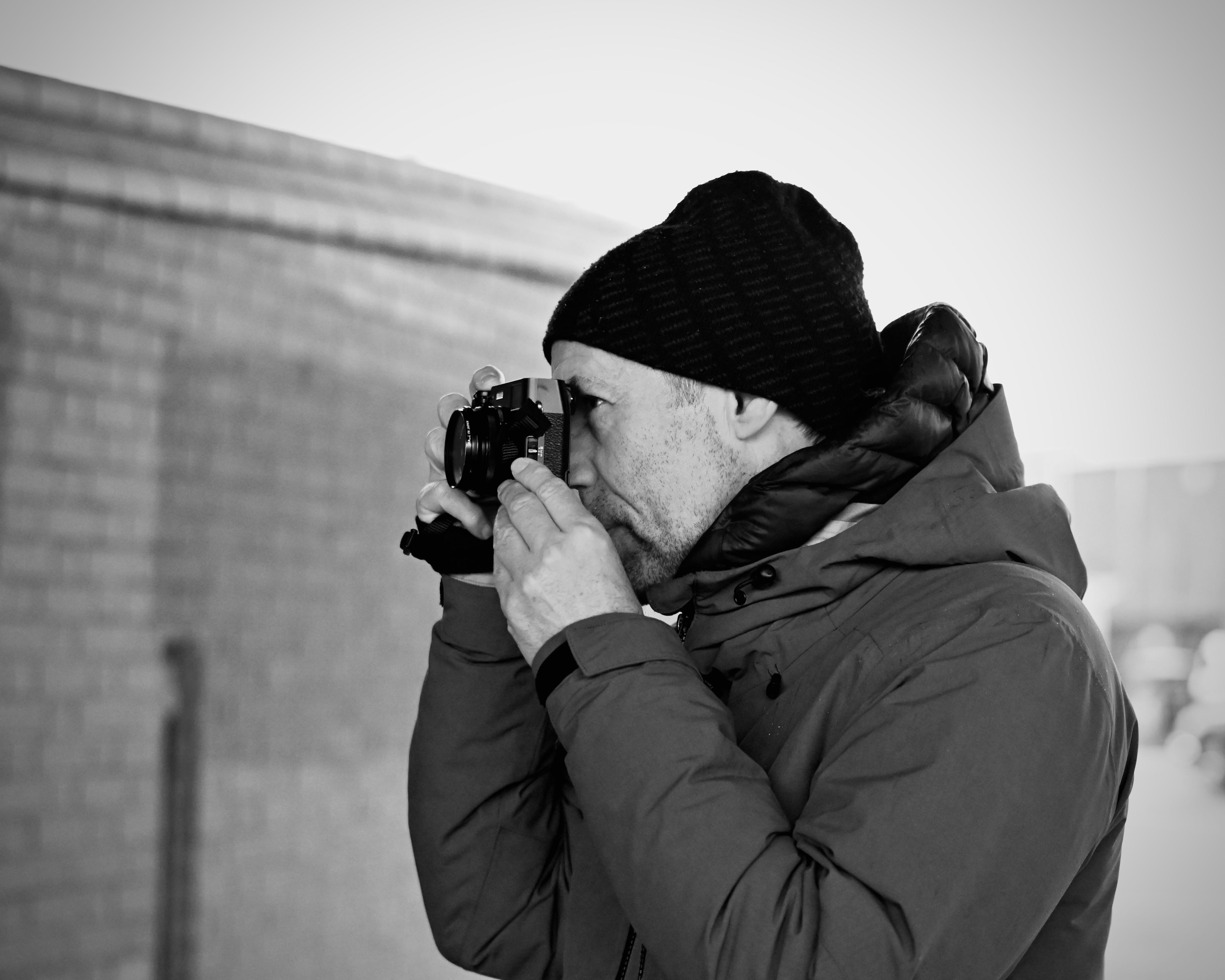
[Jeremy raises his camera to photograph some graffiti.]
What appeals to you about this graffiti?
I love photographing political graffiti, sectarian graffiti, whatever. It’s the voice of the people. It’s what people are thinking right now. Maybe it’s not interesting as a photograph, but in 20 years, 50 years, 100 years … I think in the very long term about my pictures.
You have some incredible photographs from the nineties in your recent zines, particularly the black-and-white ones from the shipyards and fishing boats. But the ones I’m most drawn to are the photographs of Roma communities in Romania. How did that come about?
I’d gone out to Romania because I wanted to be a photojournalist.
How old were you?
I was 22. I’d been out of college a year and a half, maybe. I went out in the aftermath of the revolution and stayed for four months over two trips.
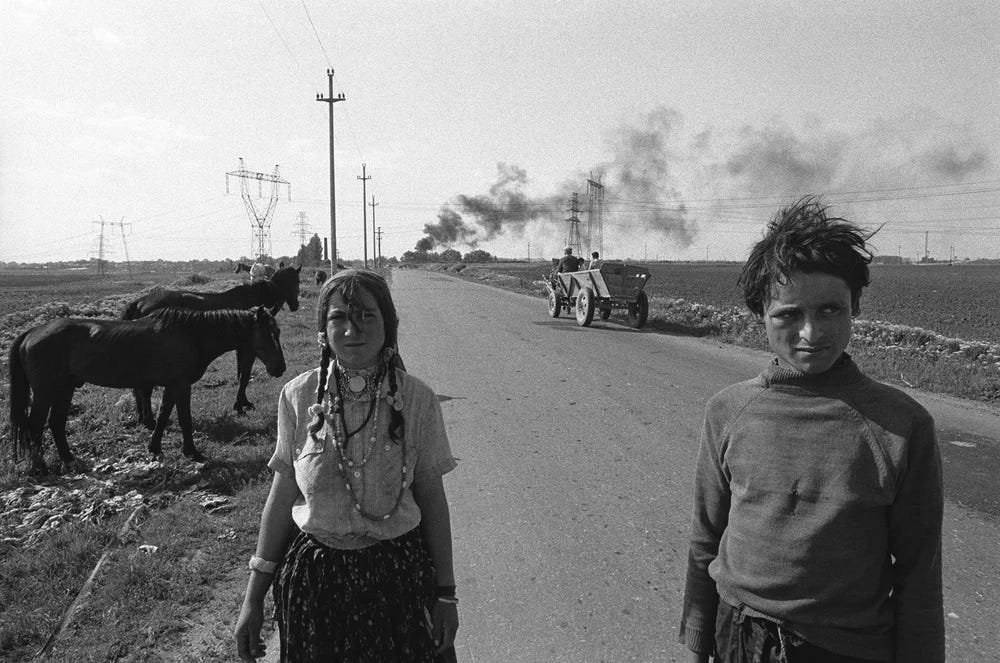
One day I was driving through the countryside and saw this Roma camp. There were tents, houses, smoke, people shouting, kids, dogs, horses, carts, everything. It was like a movie set.
A couple of days later I went back with a journalist. There was a wedding on, and because of that we were allowed into the camp. This was 1990. They were as intrigued by the outside world as we were by them.
I photographed that day, then kept going back. I went so often that I became friends with some of the families. I’d always give them prints. They’d ask me to photograph their babies, and they wanted colour pictures. I didn’t really want to be photographing a million babies in colour, but I’d do it on a little point-and-shoot camera. Then I’d get the film processed and, the next day, when I went back, I’d give them the pictures.
There were so many kids around me all the time, saying, “Take my picture, take my picture.” I’d say to the lady, “All right, I’ll give you your picture of the baby, but let’s go inside the house, away from all these kids.”
So we’d go inside. I’d give her the pictures she wanted, so she was very happy. She had colour pictures of her kids. But I was inside the house. I had access. Then I could say to her, “Let’s do some more pictures,” and we’d do more pictures. They got the pictures they wanted, and I got to photograph the Roma. They became, and still are, very good friends.


It must have been an intense experience.
I was there in the summer. It was hot, dusty and noisy. Sometimes I look back at those images and remember the situations I was in: sitting inside a tent, drinking plum brandy, eating pork roasted over an open fire, while people told me stories about living in the countryside and how they couldn’t live under a roof because it felt claustrophobic. Sometimes I look back at those pictures and can’t believe I got to experience it.
Who were your photographic inspirations at the time?
George Rodger and Werner Bischof were the two I liked most in that era, but I’d never say I went out to imitate them.
Would you go back?
The project was bound up with my translator, Toni. He was there with me, carrying my bag sometimes, helping me and translating, but also sitting and talking to people so I could have space to photograph. Two or three years ago, he passed away. It feels like the project finished with his passing, because it was a joint project. I might have been the photographer. I might have financed it and taken all the pictures, but he was as involved as I was.
Have you had any dangerous encounters doing this job?
There have been times when I’ve come close to getting a kicking. Mostly in Glasgow. It’s generally when people are very suspicious of you with a camera.
I was in Ukraine a couple of years ago, inside the Chornobyl exclusion zone, and there was a misunderstanding about where we were allowed to film. Some soldiers took objection to it. Very quickly, we were surrounded. Not quite at gunpoint, but they all had their guns with them, and they were not happy with us.
In your Artists of Scotland project, I noticed there are no photographers. Is photography not art?
There are no spoken-word artists either. There are no mime artists. A couple of people mentioned it to me. There aren’t any photographers, not because photography isn’t worthy of being an art form. It is, but … I don’t know. There’s no great reason. People sometimes try to read too much into projects.
A few years ago, you got a postgraduate diploma in Archival Studies and Records Management, and you now offer archival services to others. You occasionally hear horror stories of people losing half their negatives in a flood.
It does happen. People do lose everything. Before my archive went to St Andrews, I digitised about 14,000 pictures. I can quite easily call up 90 to 95 per cent of what I need. Occasionally someone asks for a picture I haven’t digitised, but all the important stuff is digitised.
What recommendations do you give people who come to you for advice about archiving?
You have to think about it. You have to take care of all your pictures, or else what are they for? A lot of photographers should be thinking about getting their archive organised, getting it catalogued and ultimately trying to find a home for it. All these institutions, museums and universities aren’t going to take every photographer’s collection. They can’t. There isn’t enough shelf space.
A lot of people’s work just disappears when they die.
I’ve got a list of photographers in Scotland whose work should be archived. One of them was a colleague of mine who died six years ago, a guy called Gerry McCann. We were never super close, but we knew each other. We helped each other occasionally, and I always wondered what happened to his career. What happened to his archive?
He had 40 years of work from Ethiopia, Romania, Sudan, the West Bank and all sorts of other places. I put out some feelers and found that, after he died, his extended family had taken his work to Germany. It was in a lockup near Frankfurt, sitting in cardboard boxes.
I said to his family, “What are your plans for it? What are you going to do with it?”
They said, “Well, we don’t really have a plan. We’ve been waiting for an email like yours to arrive.”
I said, “Well, if you give me permission, and you trust me a wee bit, I’d like to represent it and try to find a home for it.”
It took about a year, but his whole archive, 40 years of work, was acquired by Edinburgh University. It gives me great satisfaction that his archive is safe.
And your own archive, now held by St Andrews?
My archive has changed location, but I still have access to it. I still have the copyright. It’s in a safer location, and it doesn’t weigh heavily on me anymore.
One thing I discovered is that it’s exhausting to deal with your archive. You shouldn’t leave it to your family because it’s too big a project. I’d find envelopes and negatives that hadn’t been captioned, but I knew that in a box over there was a magazine containing the pictures. So I could reconcile the two, extract the information, put it on the negatives and properly file them for once. If I’d left that to my wife or daughter, they wouldn’t have known.
Martin Parr was obsessed with the idea of getting everything into a book, because then there are all these copies out in the world and it’s no longer one person’s responsibility. Is that what you’re doing with your zines?
Doing a zine gives the images a new life, gets them back out there. I printed a hundred of each zine. It’s much better that a hundred zines go out to a hundred houses than that the images sit on my hard drive and nobody sees them. And the pictures often go back to the communities they came from.
Thank you, Jeremy.


Jeremy Sutton-Hibbert’s photographs of Nelson Mandela’s two visits to Glasgow are being exhibited in Glasgow City Chambers between 8–30 October 2026, as part of the Season of Photography. A mid-career retrospective of his work is planned for Street Level Photoworks in 2027.
An interesting read 👍
Crepuscular is a word to use more often 😂!
Maybe I’m morbid but I often think about the subject of what happens to my photos when I die. Obviously I’m not in the same category of photographer, most people aren’t, yet there’s this huge enormity of pictorial evidence of our lives that will end up being lost from the cloud when the accounts stop being paid, and I’m sure as hell my son won’t sift through portable hard drives!