


As a keen observer of the zeitgeist, I never tire of attending art school degree shows. The students’ concerns are a cultural barometer. They help us understand whether we are in a radical or conservative period, and whether the next generation fears or embraces the future.
One trend I’ve noticed in recent years is a significant increase in painting. Unwieldy conceptual installations are out; canvases are in. It makes sense: the painting is the art commodity par excellence. It’s unique, has a strong lineage, and is relatively easy to transport and store.

Back in November 2025, BBC News excitedly reported that David Shrigley was attempting to sell piles of old rope for £1 million. Like Maurizio Cattelan’s Comedian — a banana gaffer-taped to the wall that sold for $5 million — people love hearing about the rich frittering away their money on nonsense.
Three months later, news emerged that Stephen Friedman Gallery — Shrigley’s dealer — had gone bust. The rope was presumably a last-ditch attempt to remain solvent. And it had failed.
The closure provided further evidence that the art market is in crisis, with geopolitical shocks and economic downturns leading to a 15% slump in its value in 2025. Nevertheless, clues that all is not well have been there for a while.
In 2024, Dean Kissick complained in Harper’s Magazine that politics had destroyed contemporary art, saying that it was no longer “a space of spectacle and innovation”. But I wonder how much this aesthetic caution is simply the result of straitened economic circumstances. As the gallerist Massimo De Carlo says, “If you love art but have no optimism [about the wider world], then your position is automatically more conservative. You turn to solid and traditional values.” Thus, painting.
And what of subject matter? It seemed to me that many of the art school paintings have a conspicuously photographic quality. They are not necessarily hyperrealistic, but there is an objective, knowing quality. As someone who writes about photography, I didn’t understand what was wrong with just showing the photo. What did painting the photograph add to the work? What was the point?
Initially, I cynically assumed it was because people value paintings more than photography.1 However, after chatting to a few of these painters, I learned that painting is an act of spiritual resistance to the Molochian churn of digital image culture. This was fascinating to me and shook me out of my cynicism. And so, rather than paraphrase what they told me, I questioned the artists directly:
As a painter who uses photographs as a reference, what does painting offer beyond photography? How does the image change in the process?
Here’s what they told me.
Nicholson Baker
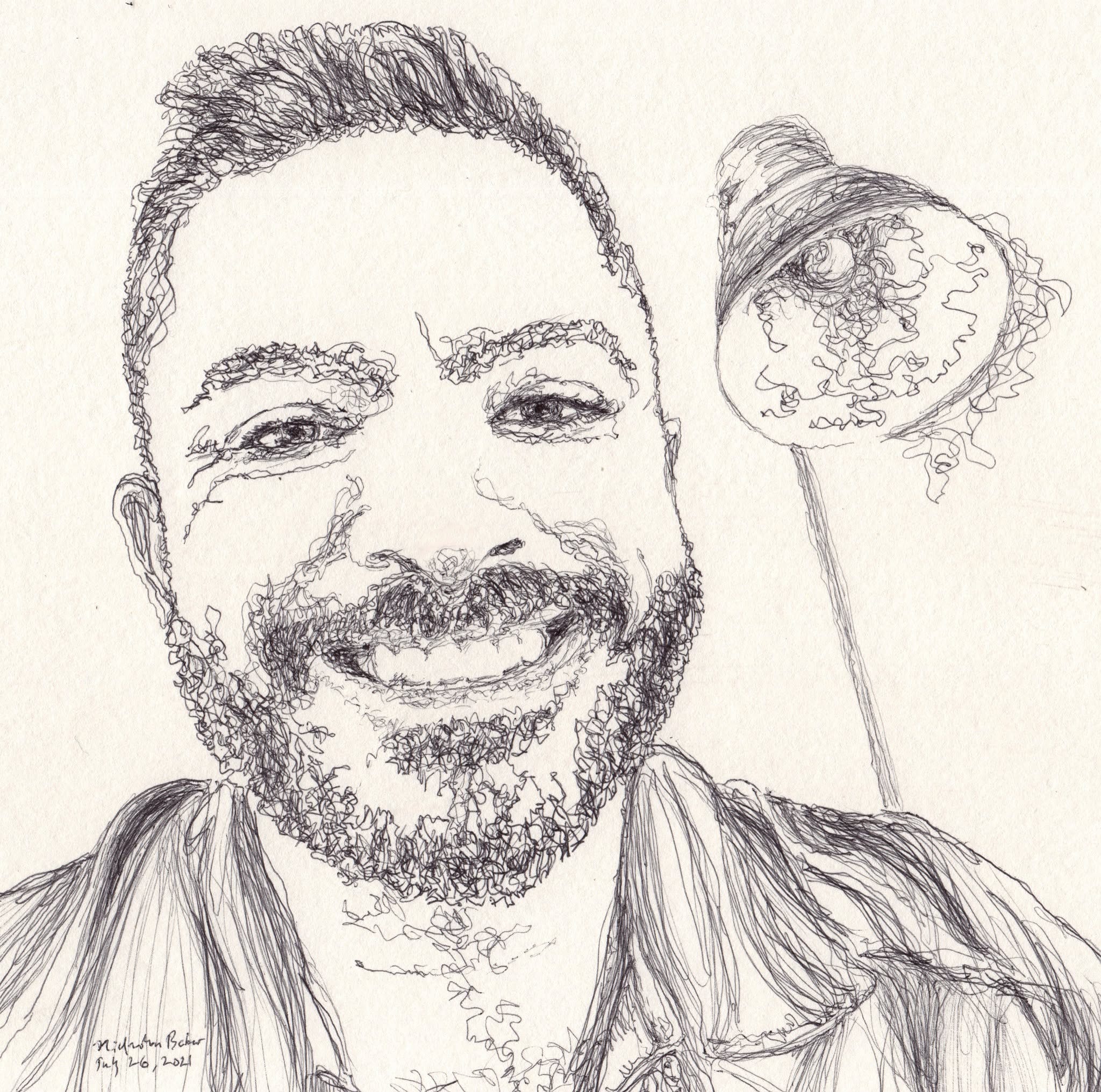
Drawing a photograph slows you down. It helps you understand the subtlety of smiles, the guardedness or guilelessness of eyes, the variable bushiness and frolicsomeness of hair. It also forces you to look at everything that’s in the photograph — the coats and hats hanging on the wall, the standing lamp, the pile of brush over to the left, the signs in the window, the loopy particularity of an earring. You become the willing apprentice to the universe of a single instant.
Check out Nicholson Baker’s Instagram or his latest book, Finding a Likeness, which contains more examples of painting from photos.2


Kate Glenn


A little over three years ago, I returned to oil painting after a hiatus of around fifteen years. My return to painting came about because I wanted to reclaim nudes I had sent to people who didn’t deserve them. I was in conversation with my past self, looking at her before she knew what was to come. In rendering myself in oil paint, I was elevating the image, creating a piece of art that would only be visible behind a paywall, which was an important part of the project.
The act of painting became an exercise in self-devotion and self-esteem building through deep observational looking and practising an old skill that was coming back to me. I was asked why I didn’t just print a large-scale photo instead of painting an exact copy of the picture. But it’s the attempt and failure in the copying that interests me.
The devotion in time and energy focused on this image, zooming in and out, attempting to colour match, spending hours on the recreation that I think becomes its own thing. It’s not exactly photo-realistic. There is some kind of distortion and abstraction that happens when I translate the photo via oil paint.
Photography isn’t the whole truth, lenses frame and can distort what we aim to capture. The oil painting takes it even further from the truth, but adds more truth at the same time, another layer to the story in the many layers of paint.
Check out Kate Glenn’s Patreon and Instagram.
William Lake Armstrong


I think more like a photographer than a painter, but the process of a painting can reveal certain truths that photography doesn’t capture. You make a variety of decisions leading up to the photo, but once you take it, the image is the image. And while you can apply edits, the core image remains constant. But painting involves a wide range of decisions made throughout the process, both intentionally and intuitively. These choices dig up aspects which, while not captured in the original image, ring true to the moments and feelings surrounding it.
When you paint from photos, you have a baseline, an original to constantly compare to. The painting emerges through addition and subtraction: you add a colour that wasn’t originally present in the capture, you remove an object that had been the centrepiece of the image, you alter an element of the composition beyond recognition. I love those elements in the painting which build off the initial photo and unearth something new. They help me to better understand not just the pictures I take, but the experiences behind them.
Check out William Lake Armstrong’s website.
Sarah Palmer


Isabelle Graw wrote about how paintings have a liveliness because they contain the artist’s time. In a world where most have in their pocket a device that can take a quick photo of relatively good quality of anything you see, painting is an act of slowness. It provides an escape from the cerebral experience back into the body. It’s also much more disgusting than photography — I think it’s James Elkins who compares paint to poo.
I always start my paintings with a photo I’ve taken. I’ve been asked if it would be better to work from memory or imagination because my paintings don’t look like photos. But I don’t think working from photos means I don’t work from memory or imagination — I’m interested in photography because of the way it interferes with creating memory. Taking my own photos interferes with the way I remember a place, but also consuming photos others have taken gives me a perception of a place before I’ve even arrived.
Consuming photos of landscapes on social media reshapes our perception of the physical world, creating a circular relationship that mirrors the picturesque: just as 18th-century viewers judged real landscapes against paintings, we now see the world through curated feeds.
I paint and repaint until looking at the reference photo becomes unbearable. Only then can the real painting begin. Recently, I’ve begun my paintings by painting a dramatic sky in a different colour to the one in the photo. This upsets the palette of the whole image. One decision early on creates a chain reaction through the whole image, so by the end, I’m not translating a photograph. I’m solving a completely different problem.
Check out Sarah Palmer’s website.
Javier Ramos Bellanco


I work from photos that I have taken myself. Or, if they are not mine, after seeing them, I feel a special connection with the image, as if the image had been made by someone else for me. I feel something special, and I appropriate it.
Check out Javier Ramos Bellanco’s website.
Vinishree Solanki


I enjoy working en plein air, but there’s also something opportune about painting in the comfort of my home using photographs as reference. I look for photographs with strong compositions of mass and negative space; sometimes it’s the interplay of light and shadow that draws me in, and often it’s a candid moment, an act or movement that might be lost in memory.
When I work from a photograph, I tend to break it down into building blocks or layers to simplify the captured moment. I study the foreground and background, perspective, and focal point, dissecting the image so I can rebuild it in my own way. This process allows me to bring in my style. I have the freedom to accentuate some colours or blur some of the details to reduce the visual noise.
Painting from a photograph becomes more than simply recreating a moment. As I paint, I have the liberty to question or even distort the truth. It becomes an act of interpretation, almost like revealing what the scene meant to me in the process of painting. I want to be more than an observer, to become a storyteller, to create a fiction beyond what is seen in the photograph.
Check out Vinishree Solanki’s Instagram.3
Notably, the most financially successful photographer at auction is Richard Prince, who makes only two copies of each work.
Actually, everything he has written is worth reading. In each case, there is a delirious devotion to exactitude. His debut novel, The Mezzanine, details a lunch hour. The Fermata imagines reality pausing like a photograph. And Human Smoke explores the moral horror of the second world war.
The first inkling for this post came after I saw Vinishree’s painting based on my photo. She said at the time:
A stranger, no idea who, where and when. The answer may only be with @mr.neil.scott, whose brilliant street photography is full of those mundane and beautiful moments. I used this photo from Neil’s album as a reference to paint this.
It seems like slowing down is a young person’s need and concern, delivered by a brush, paint and canvas. I get it, I really do! Excellent. Thank you.
useful corrective to my slightly eyerolling prejudice against photographic paintings! I'll think about this next time I see one