


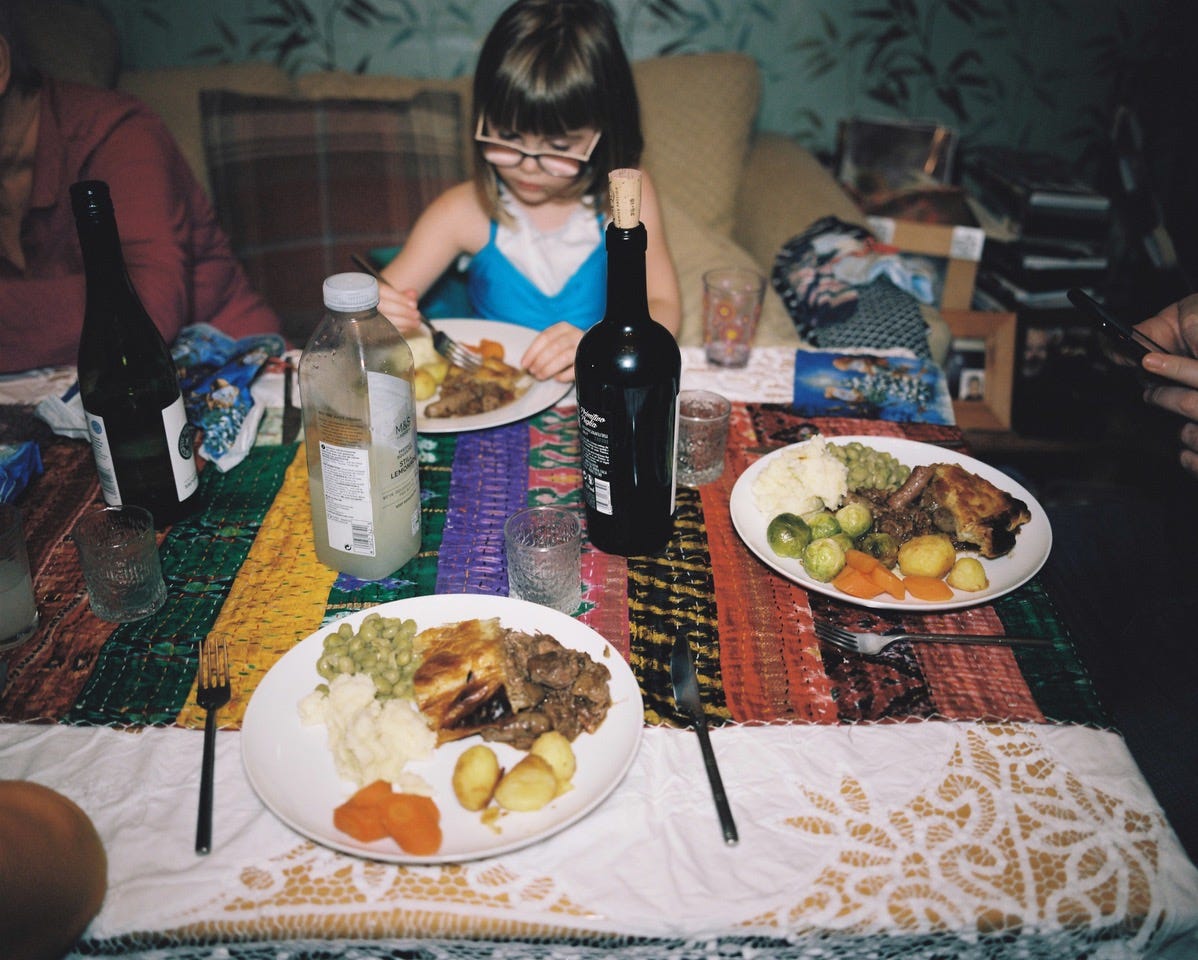
Kirsty Mackay grew up in a tenement in Partick and now, after several decades in England, she has come home to Glasgow. Her photobooks, particularly The Fish That Never Swam and The Magic Money Tree, go beyond observing class and poverty, using collaboration and research in an attempt to change policy.
Ever since I learned she was moving back to Glasgow, I wanted to interview her for The Crop. The opening of her new exhibition, Here and Then, at the Liberal Club in Paisley gave me the perfect opportunity.
Tell me about your new exhibition, Here and Then.
It starts with my home. My mum’s still in Partick, in the same house we grew up in. Then it’s about the city. I’ve separated the women’s portraits from the men’s portraits, as there’s a whole set of issues affecting women and quite another set affecting men. And the last section is about agency, power and resistance.
It’s rare to see a straightforward photography exhibition these days. Is there going to be fabric or vitrines…
This is quite a straightforward exhibition. Refractive wanted beautiful prints, although the very largest ones will be vinyls. They’re about a metre tall.
And is there going to be text?
Yes. I’m writing a narrative non-fiction book set in Glasgow, and there’ll be snippets of that in the exhibition.
And what’s the book about?
It’s storytelling, but it’s all rooted in things that happened. I’m using my mum’s tenement block as a portal to tell these stories. In a lot of the scenes, I’m coming home: coming home from school, or coming home after living in England for decades. But it’s mostly the stories of the young men I grew up around, and that path of a young man growing up in a working-class area.
When you announced the exhibition, you wrote about the extent to which place of birth dictates our future. How do you answer that now?
I have been writing about my next-door neighbour, Billy, who died by suicide. Billy’s life was set on day one. I really believe that. His family describe it as a good family, but his dad was an abusive, violent man. There was nothing Billy could have done, short of some miraculous intervention. Even the steps Billy took to build his own life, his dad managed to shatter. For some people, the forces of their environment are far greater than what they can overcome on their own.
Have you thought about how your life might be different if you’d been born in bourgeois Hyndland rather than working-class Partick?
I would have less anxiety. The biggest issue in Partick at the time, in terms of its impact on my life, was that I was born into violence. I know I wouldn’t have as much anxiety if I’d grown up somewhere else. I remember going out to play as a young kid, and two girls I was playing with pinned me against a wall and held a match under my chin. I was four or five years old.
But you were able to move away?
When I think about my social mobility, it was the state that provided that for me. It wasn’t that I was more talented than the people around me. I got a grant to go to college. When I went to university, I got my fees paid. When I moved to London, I got housing benefit till I got set up.
One thing I especially like about your work is the balance between individual identity and information about rates of poverty. How do you balance the personal and the statistical?
What I’m good at is meeting someone, taking their photograph, and then talking to them in a way where they feel safe to open up. Partly that’s because I’ve taken a photograph beforehand – we’ve been through that together, and it’s quite a connecting process – so I get people’s personal stories. But my viewpoint is zooming in and then zooming out. Part of my research process, when I’m not photographing, is looking at everything else that’s happening.
So you studied photography at college and then started working as a photography assistant in London?
I was very ambitious and wanted to be an assistant to a fashion photographer. At the time, all the fashion photographers I liked were in New York, so I went there to try and get my dream job. But I only had three months on my visa, so I didn’t get it. I came back to Glasgow and then, reluctantly, went to London, where I worked freelance as a photography assistant for fashion and advertising photographers.
What photographs were you taking at this point? Did you have any of your own projects?
I didn’t take photographs for years after I left college.
For those who don’t know, what is an assistant’s job like?
It’s about taking the technical responsibility away from the photographer so they can focus on the image-making. You’re controlling the exposure and setting up the lighting. It was all on film then, so you’re noting down all the details, sending the film to the lab.
And there was no screen back then to preview any of the pictures.
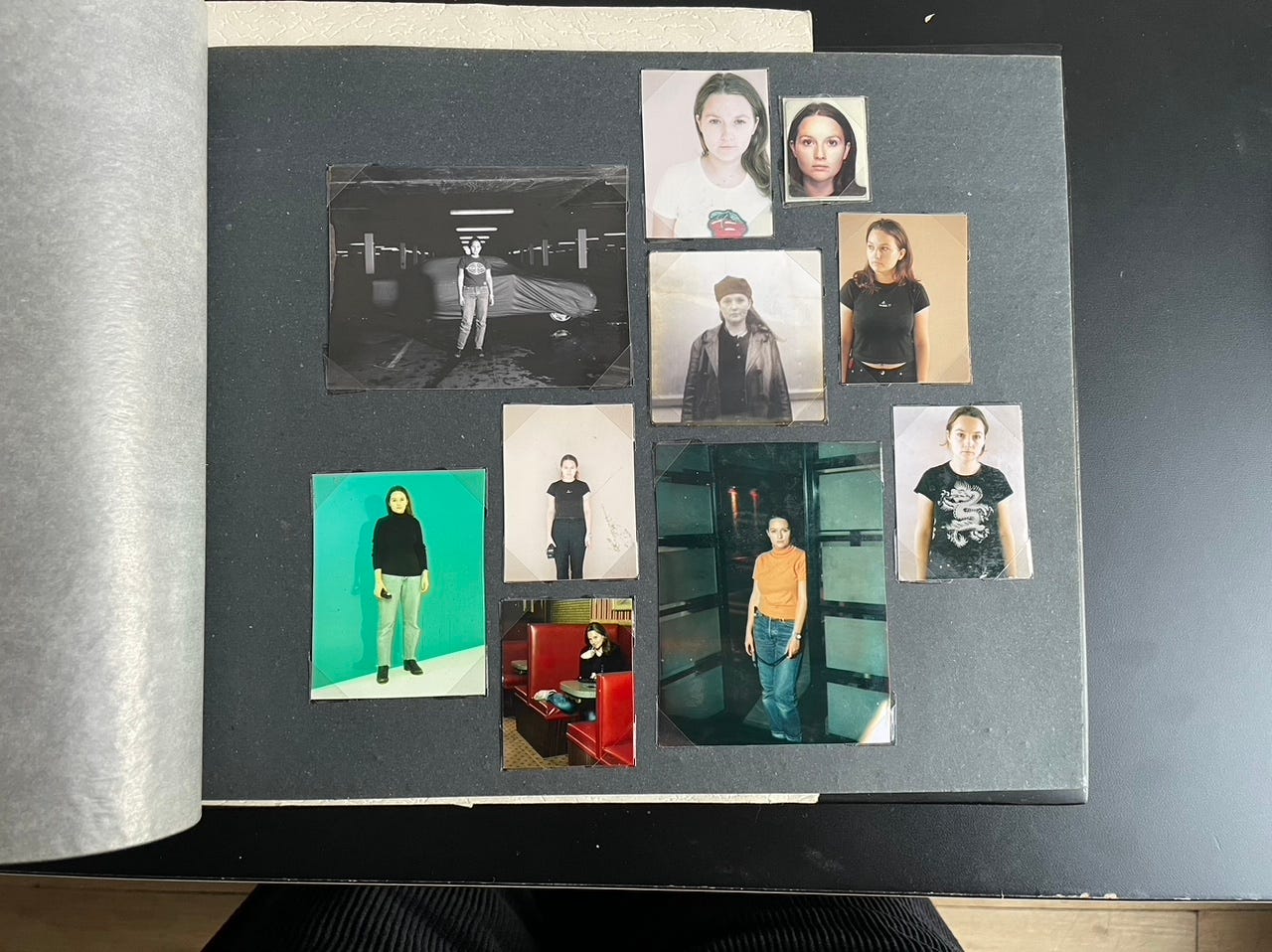
No, so I’d be taking Polaroids, or standing in for the model to check the lighting. I’ve got hundreds of old Polaroids of me standing in front of their set-ups.
How did you go from that to doing the MA in documentary photography? Had you had enough of fashion?
I thought I wanted to be a fashion photographer. I started doing test shoots with models and found out it wasn’t for me. I was interested in fashion, but I was much better suited to being on my own with the camera.
Because there were all these make-up and costume people around?
In fashion photography, you have to be a director. You’re directing a hairdresser, a make-up artist, a stylist. It’s a big production, and that didn’t suit me at the time. When I moved to Bath, I would go to Bristol and stop people on the street and ask to take their photograph. It was a street-fashion type of thing, which was a bridge between the two at that point. Then I dropped the fashion and became interested in documentary photography.
The 90s are in the air a lot at the moment, with the controversial new exhibition at Tate Britain. What were they like for you?
The 90s were a great time for me. I could afford to live in central London. There was plenty of work. I worked with photographers like Nick Knight and Anton Corbijn. I got to travel to Bali, the States, Iceland, India. There was loads of location work.
No one ever talks to you about this part of your life…
I don’t talk about it, because I feel fashion was a bit of a distraction for me – a shiny thing that caught my attention but wasn’t quite right for me. I didn’t really find my subject matter until after my first book, My Favourite Colour Was Yellow; really, it was when I started working on The Fish That Never Swam. That’s when things fell into place. The other stuff wasn’t quite me, though it was good fun and good experience.
I don’t know if you’d call yourself a late bloomer.
It’s part of being a working-class woman. It’s taken me a really long time to get where I want to be. If I’d grown up at the top of the hill, maybe it would have been quicker.
You might still be doing fashion. Maybe you wouldn’t care about social issues. No one wants their life to be different, right?
Yes, it’s because I’ve had all those experiences that I understand the working-class experience. If I hadn’t had that, I wouldn’t have made The Magic Money Tree. I haven’t lived in poverty per se, but we definitely grew up on the breadline and were surrounded by people experiencing poverty. That experience was absolutely crucial to my even wanting to make The Magic Money Tree.
I know lots of middle-aged photographers whose urgency comes from the fact that their time is finite. Is that something that motivates you, or is it more about the activism?
I’m not thinking about time. I’m thinking about what feels most pressing. I had wanted to make a body of work about poverty, and then the cost-of-living crisis came along, and the project became something concrete. It felt very urgent. And now, since I moved back to Glasgow, I’m concerned about the escalation of the far right. That feels really urgent. I’m not thinking down the line. I’m thinking: I need to do this now.
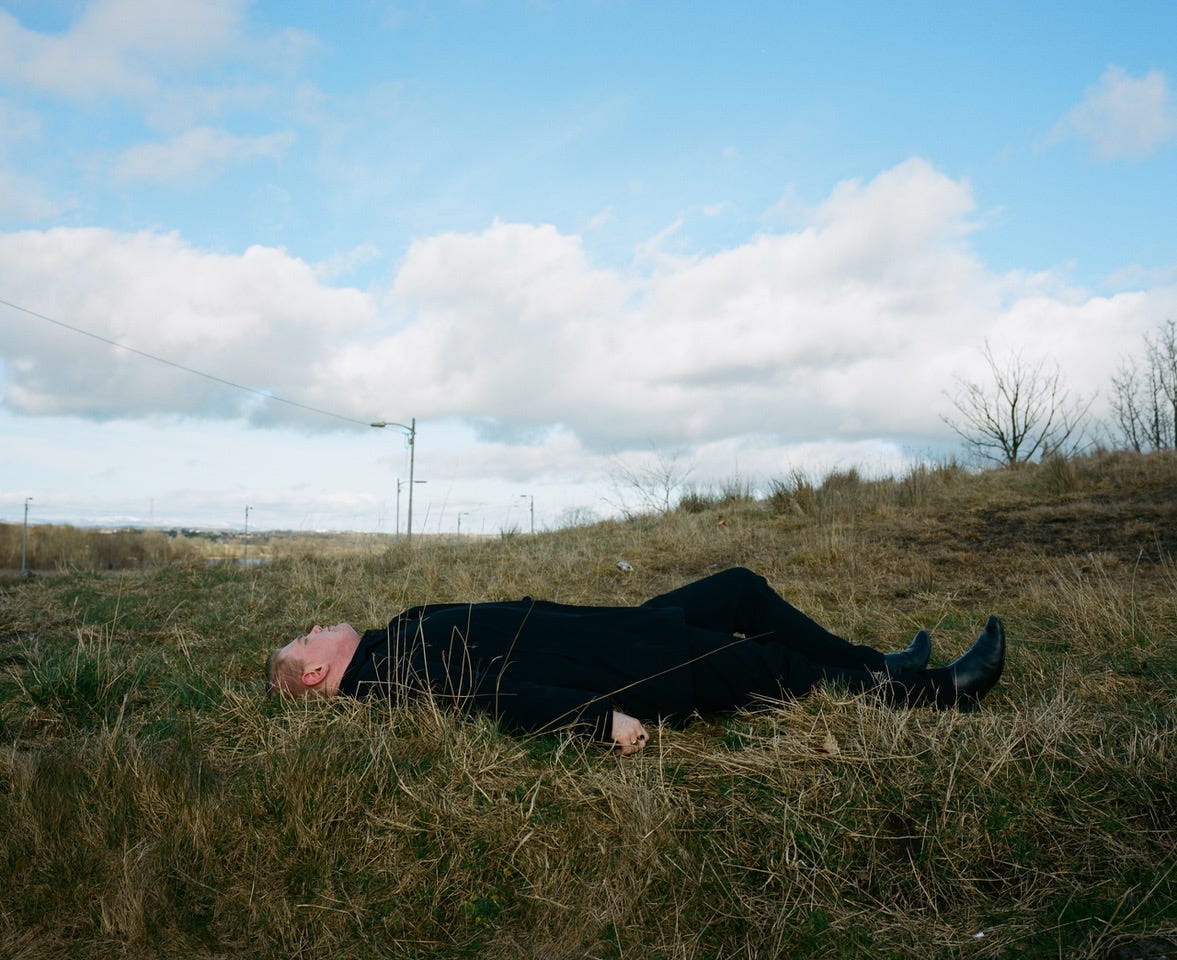
There are a lot of radical artists whose work is ostensibly political but whose societal impact is zero. Your work has the potential to be very influential – in the way Andy Burnham was talking about Darren McGarvey’s book Poverty Safari the other week. What do you think about the impact of your work beyond the gallery?
What propels the work forward is this sense of: if only people knew what it was like to live in poverty. When I made The Magic Money Tree, I thought maybe something would change. But I know the sphere of change you can reach is quite small. I know my work has changed people’s minds and influenced them, but it doesn’t bring change on a big scale. I think that’s okay – you do what you can. I’ve found the little space where I can use my skills and experience to do this thing.


You recently had a beautifully executed exhibition in Govanhill about the anti-immigrant protests in Glasgow. My experience of these protests is that it’s a lot of middle-class people and working-class people shouting at each other. Obviously any far-right agitator deserves to be condemned, but the people I see out there seem to be subject to the same deprivation as those you photographed in The Fish That Never Swam. How do you reconcile all this?
That’s a really good question. The last protest I photographed was the Pink Ladies one, in August at Glasgow Green. The two sides were completely separate, with the People’s Palace in the middle. The counter-protest was hemmed into a fenced area, and the Pink Ladies were hemmed into another enclosure on the other side. I didn’t want to be hemmed in, so I went into the Pink Ladies’ enclosure. They came on stage and talked about sexual violence they had encountered, and I was standing beside two other women who were sharing their own experiences of sexual violence. I thought: this is an issue I could connect with them on.
But I think it’s really important that the counter-protest is there. Those counter-protests have had a lot of success. In Erskine, they completely defeated the people protesting outside the hotel. They’ve made a big change in Falkirk. If those people hadn’t been at the counter-protests, the far-right protests would still be going and would have felt more confident. But because they kept getting outnumbered, it eventually fizzled out.
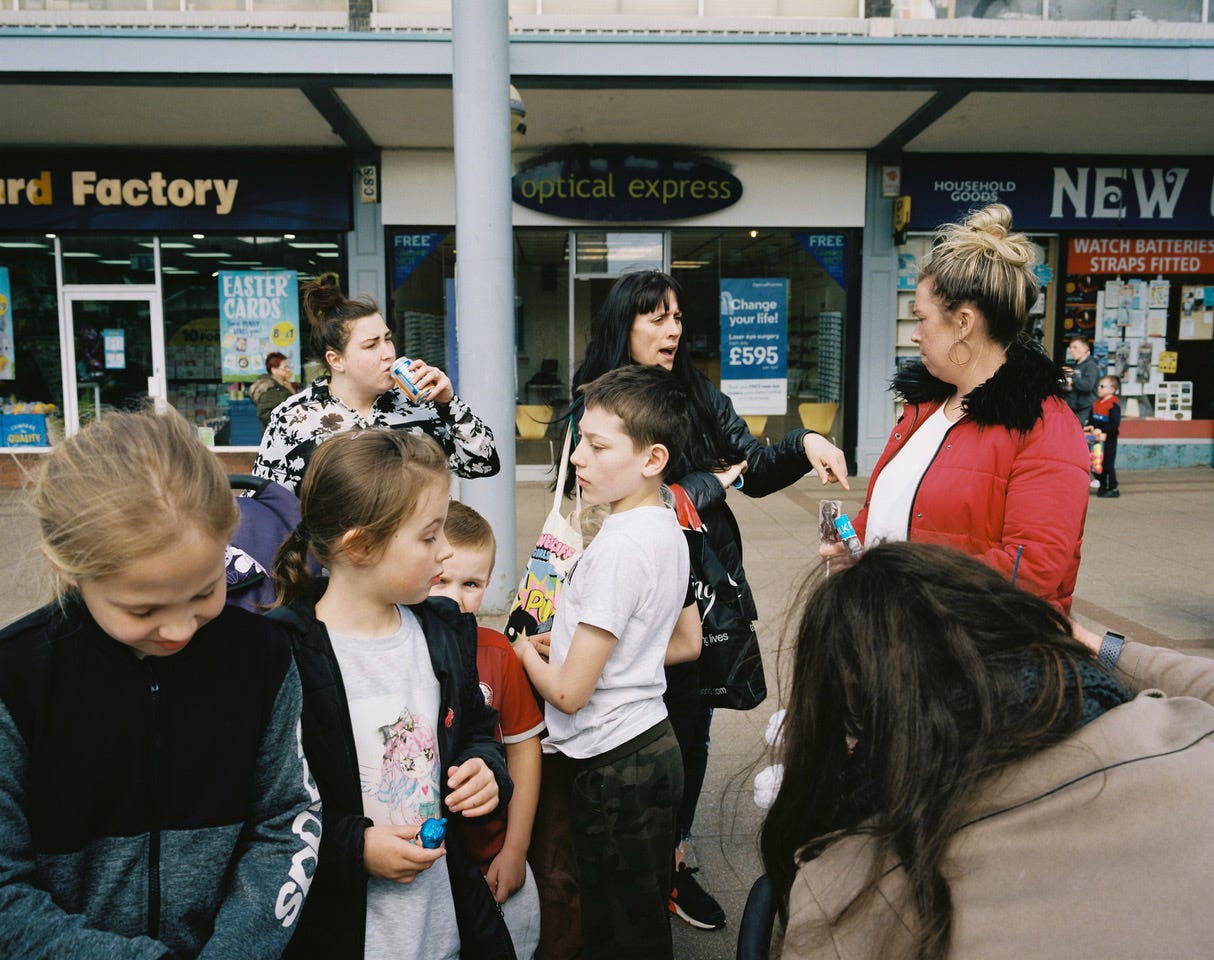
When I first encountered your work, it felt like it posed a massive challenge to me. By any reasonable ethical measure, I have a responsibility I’m not taking.
Really? I don’t understand. Why?
Because my introduction to photography was through street photography. I wasn’t Bruce Gilden, but I was still pretty extractive, and I never asked permission. What do you think of photographers like that?
I looked at the work of Martin Parr and Dougie Wallace, and I decided to go in the complete opposite direction. But I think there’s room for everybody. We all have different perspectives. There are so many ways to take a picture, and so many points of view we haven’t even seen yet.
But I will stand in the street and take pictures of people as they walk by, because I do want those photographs where you’re intruding on a scene very minimally and capturing people as they naturally walk down the street. But if someone doesn’t want their picture taken, I won’t take it. I don’t want to photograph people who don’t want to be photographed. I don’t assume the right, but some other photographers do, and that’s down to a sense of their own entitlement.
But you wouldn’t ask for consent after the photograph has been taken? I’ve heard you talk about how, with The Fish That Never Swam, you get permission from the subjects whenever it’s republished in a different context.
Sometimes I would take a picture on the street and afterwards say, “Oh, I took your picture,” and get chatting. But I’ve got pictures where I haven’t spoken to the people. My preferred method is to get to know people, photograph them in their house, keep in touch with them, and then check in with them down the line.
Have you spoken to everyone who features in the new exhibition – Andrea [Flannery O’Kafka], for example?
I’ve spoken to Andrea and asked her permission to use the picture. I’ve shared the spread so she can see the context it’s being used in, and asked if she might write a line or two about when we took the photograph. I haven’t yet gone through every single person and told them about the exhibition, but I will, and I’ll invite them all to the opening.
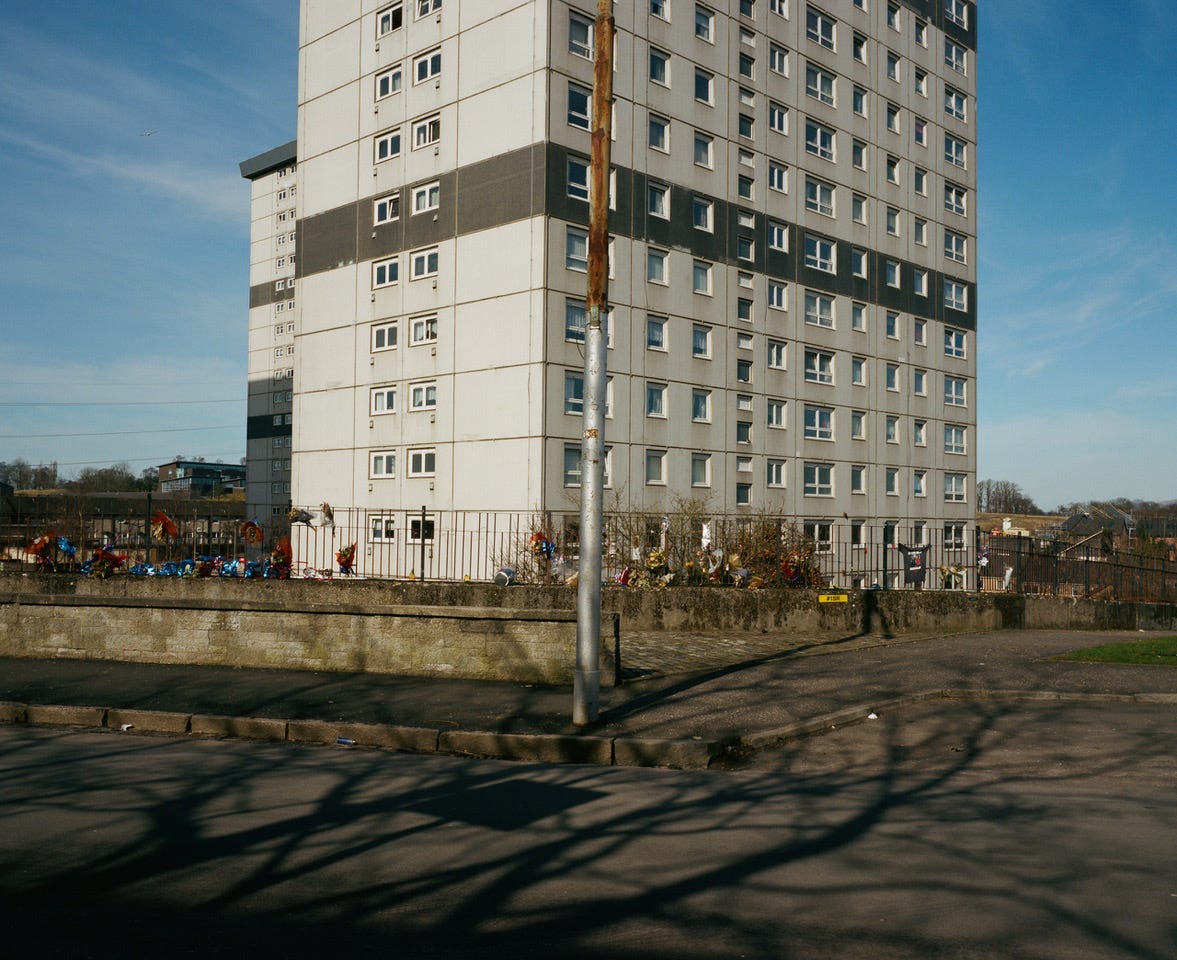
I’m curious about what you look for in a photo. For this show you have 31 pictures, and presumably an archive of thousands. What makes you choose these 31?
In this exhibition, I’m trying to show an image of Glasgow as a place. So I start with pictures of my home life and from my mum’s house. Then I’m choosing the pictures that articulate the personality of Glasgow. I’ve been trying to pin that down in my head since I was a kid.
Can you remember when you first became aware that you were a Weegie?
Maybe at nine or ten. We got to choose our own projects, and I did one about Paris and one about Partick. I went to Partick library and did my research. It was about Partick, but also about Glasgow, and it had a drawing of the city’s crest – the fish, the tree, the bird and all that. The poetry of that really fascinated me.
And when you went to London?
I got comments about my accent. People would tell me to get elocution lessons. I started to understand how differently Glasgow was seen from England compared to how it’s seen from Glasgow.
Even the word “tenement” – people assume it must mean slum. Did you rebel against that in London?
It was really bloody annoying. You push back on it, but it’s draining. So you let people have their own ignorance.
Have you had it from the other side – people in Glasgow saying you’ve changed?
I’m sure that’s there. When you move, your accent changes. But I feel I’m faithful to the place I grew up.
Imagine that all social, economic and gender problems went away. What work do you think you’d make?
I’d have a bit less purpose, but maybe a bit more freedom to choose my subject matter. I do feel it’s essential for me to make this work, but I might get to a point where I’ve said what I want to say and can move on to work that isn’t all about class. I can see that being a possibility. Maybe one day.
Thank you, Kirsty.


Here and Then by Kirsty Mackay
A photography exhibition about home, connection, class and the lottery of birth.
Saturday 14 November 2026 – Saturday 9 January 2027
The Liberal Club, 32 High Street, Paisley PA1 2BZ
Tuesday to Saturday, 11am–6pm
An interesting read… clearly a comfortable discussion 👍
Great conversation!